User Research
When organizing a group buy, it's important to start by understanding your end goal and your target consumers. Failing to align on a single core purpose can make your setup appear unstructured and disorganized. If you don't understand your consumers, who they are or what they want, you may wind up building the wrong thing.

Understanding Services and Needs
A group buy provides a service to the consumer. Consumers use group buys to help them get things done (for example, receiving products directly to their door, third-party testing of a batch, or lowering the risk of delays caused by reships). These are their needs, and a consumer is searching for a service that satisfies them.
Group buys designed around consumers and their needs:
- Are more likely to succeed
- Have returning customers
- Cost less to operate by reducing the time and money spent resolving problems
Researching User Needs
Once you understand what your consumers need, the next step is confirming the market can meet it.
Build on what people know
Rather than bidding on an exhaustive list of every possible product, focus on the most relevant ones. You can use campaigns launched by competitors, social media platforms, and community forums. Gaps here tell you where demand may be building. By focusing on relevance and popularity, you create the strongest intent signal you can get.
Think like your customers
Consider the needs people may have to consider a group buy like yours. Consumers may want to secure a good deal, get a product quickly, or ensure that testing is extensive and transparent.
Ask your consumers directly
Signals and educated guesses only get you so far. Post an interest check where your consumers already are (Such as, a poll, a form, or a pinned thread) and count the responses. Treat any opinion that does not come from a consumer as an assumption that still has to be proven. The interest check is what gives you the numbers, and if you don't have the numbers to back up your group buy, the group buy doesn't happen.
Write down what you learned
Research only counts if you can show it. Summarize your findings into a short thread or statement that the rest of the group buy is built on:
Consumers need [product] at [dose or format] so that [outcome], backed by [evidence].
If you can't fill in every blank, you aren't done researching. This statement becomes the foundation for Planning & Setup, the product list, and your marketing.
Decide: yes or no
This is the gate every group buy must pass before planning begins. Move forward only when all three are true:
- Demand — your interest check cleared the minimum numbers
- Product— the product can be third-party tested and doesn't conflict with Regulation, Restriction and Exclusions
- Supply — at least one credible vendor can meet the spec at volume
If any of these are unmet, park the buy or keep researching. Skipping this gate doesn't speed anything up, it just moves the failure later, where it costs more.
Planning & Setup
Once you've completed your research, the work shifts from pinpointing demand to building your group buy. Each thing a participant sees, uses, or saves comes from this stage is uniquely built on the research you've collected.
Whether you're new to organizing or you've been working them for years, finding the technology you need is an important first step. With so many technologies available to you, it's sometimes difficult to know where to start. The following topics offer a high-level view of the technologies available to you, and guidance about which technologies you might choose to solve particular problems.
Pricing and Profitability
The second most important thing of facilitating a group buy is considering whether the services a merchant provides has an equivalent value in sales. Too low in profits, and you're in the negative. Too high, and you'll barely pull in any sales.
Rule of thumb, start by calculating the minimum order quantity provided by the vendor.
Choosing or building a form-building tool
Deciding between building an interface to receive or retrieve orders and using a web based form tool may be confusing. The difference is pure necessity. When choosing, ask yourself these three things:
- Do I have the skillset required to create a fully customized, fully integreted form?
- Is there enough time to develop this form?
- Would this form be what a participant expects?
If you answered 'no' to any of these, you need to search for a web based form tool.
Ezformz
Ezformz is a free, web based survey and form building tool. Each form offers mobile friendly straightforward ways to build your form, and fetch only the data you need. They also offer features you'd expect, like duplicate tracking, order status, and integration with Google Sheets.
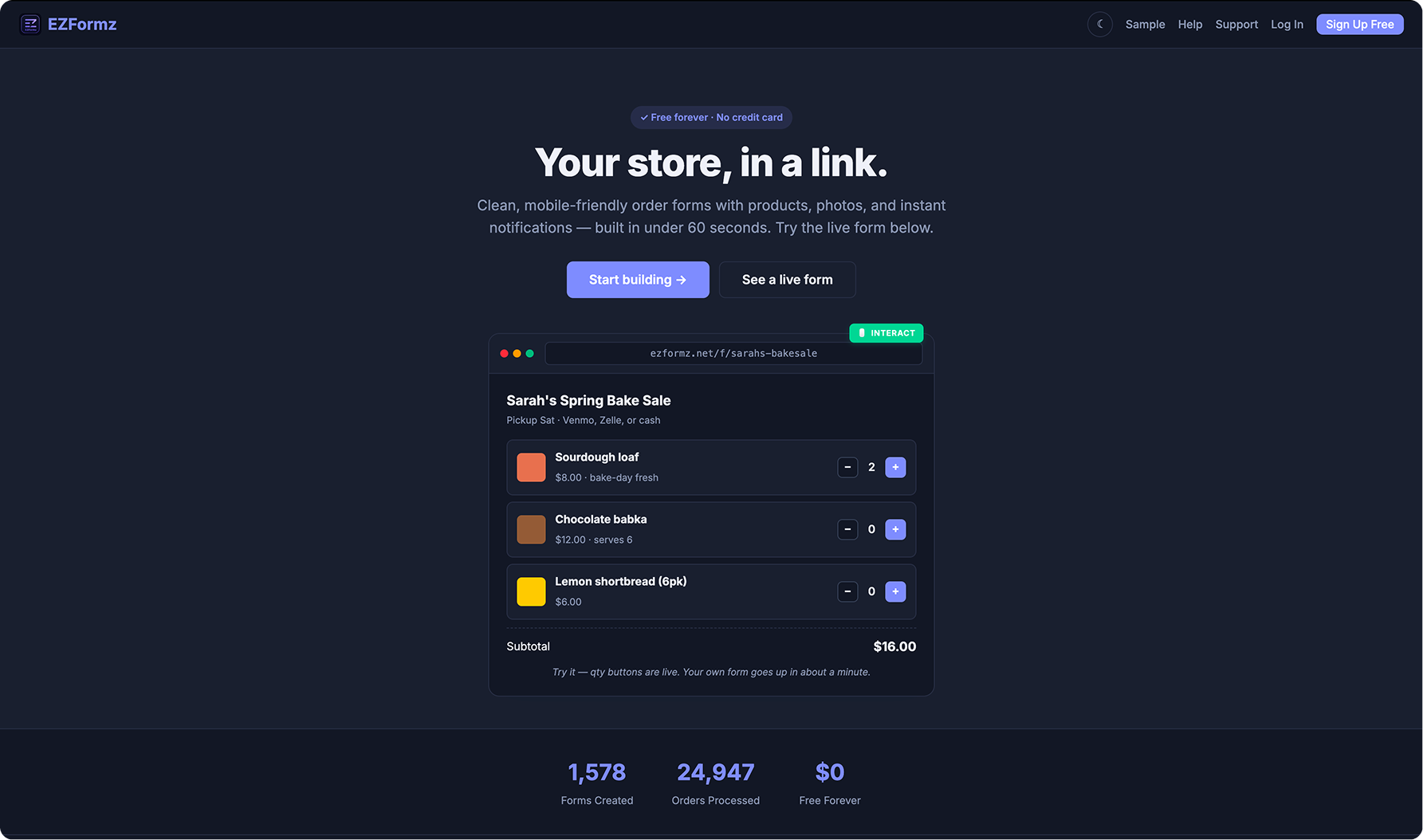
After you've chosen tool or built your framework, you can move on to what information should be collected on this form.
Design Checkout
Checkout records a transaction, sale, or agreement made between a seller and buyer. You can utilize prebuilt UI customized to your needs, third party web based tools, or an embedded form linked in your website.
Bohemia lets merchants use whatever form, portal, or third party tool to create a checkout for buyers. Sensitive information should only include what's necessary to ship the buyer's order, such as:
First, last, middle names
Username
Home, Private, PO Box, or Private Mailbox Addresses (PMB)
Email address
Phone Number
VAT/Tax ID information (for international orders)
Method of Payment
Payment Information
Checkout's should also include enough guidance and information for a user to make an informed decision. Products, descriptions, images, fees, and options should be clearly listed on the checkout form. The standard is displaying all instructions, requirements, terms, and conditions in an easily-readable, accessible format.
The form, content, information, intake portal, and all required documentation, collectively the group buy documentation, is the single source of truth for your group buy. This is where guarantees, testing plans, timelines, and pricing live in a format participants can view, use, and save.
Guidance on Specifications
It's important when writing specifications that merchants adhere to market expectations. User's expect a standard, when unmet, can be particularly angsty. Avoid:
Vague or confusing guarantees
"97% Purity and 95% Mass" when the {vendor} usually guarantees 99% purity and mass or higher"
"{vendor} says since this is a custom-made batch, we are only guaranteed {mass}% and {purity}%."
Poor sentence structure, grammar, or tone
"Testing Mass Purity Janoshik."
"It is the last day of the buy get those final orders in by 3pm eastern, noon pacific!"
"Please do not buy from us if you cannot read. I'm sick of this, do better!"
Announcements, Updates & Status Checks
Participants follow the status of a group buy through timely, accurate, and transparent public updates. Plan where announcements will be posted and how often before the buy opens, not after.